:How One Compact Adjustable Dumbbells Set Replaced My Entire Weight Rack
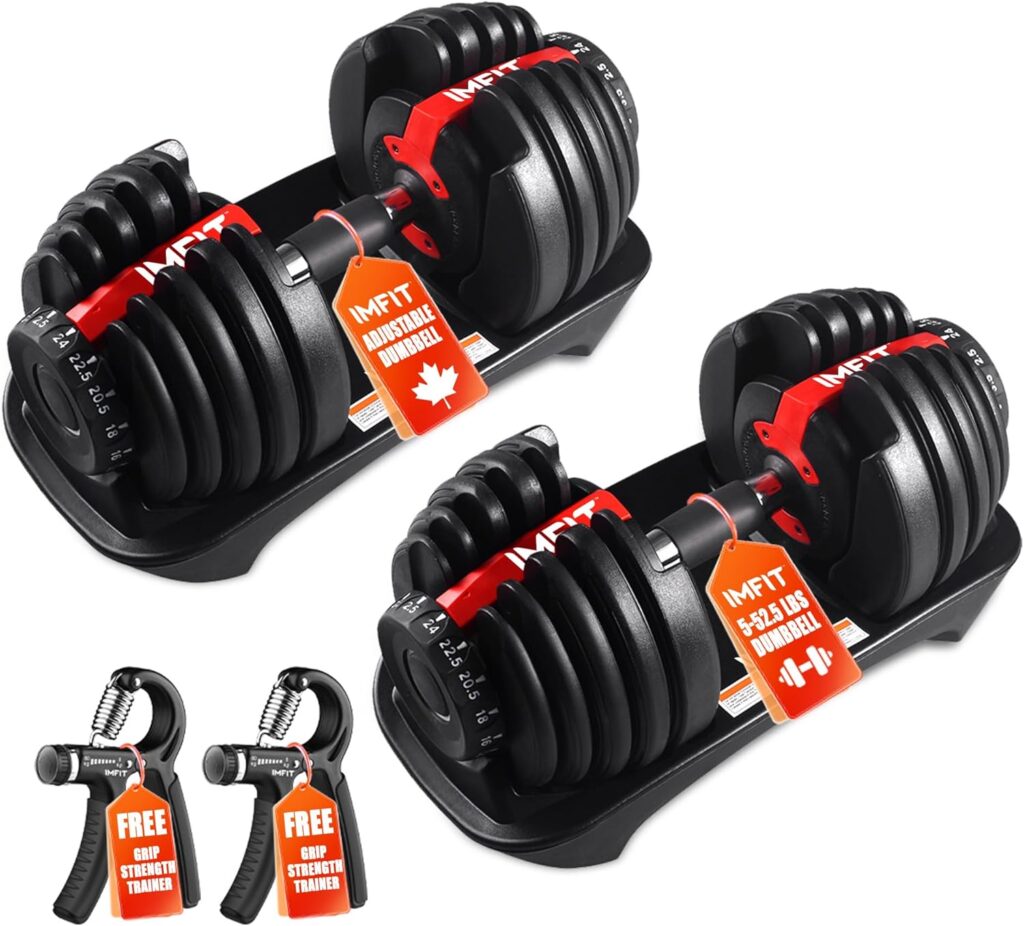
The first time I tried to build a home gym, I made a beginner mistake that cost me about $400 and half my spare bedroom. I bought five pairs of fixed dumbbells — 10s, 15s, 20s, 25s, and 30s — convinced I would “grow into” the rest. Within two months I had outgrown the 30s on rows but was still using the 10s for lateral raises. The rack stayed. The clutter stayed. The regret stayed.
Then I switched to adjustable dumbbells, and almost every problem went away. One compact pair handled warm-up curls and heavy goblet squats. The floor cleared. My family stopped tripping over weights at 6 a.m. The training got better, too — because suddenly I had no excuse to skip lateral raises just because the right weight was on the other side of the room.
If you are weighing the same decision in 2026, this guide is for you. I will walk through how adjustable dumbbells actually work, what to look for before you buy, where they fall short, how to program with them, and how the IMFit 5–52.5 lb set — currently one of the most popular adjustable dumbbells on Amazon — stacks up after real use. No fluff, no recycled product copy, no breathless hype. Just the things I wish someone had told me three years ago when I was still tripping over those fixed dumbbells.
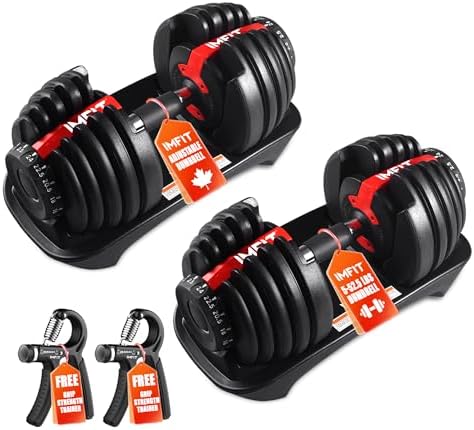
- Conveniently Switch Exercises – With IMFIT adjustable dumbbells, you can effortlessly transition between different exerc…
- Space-efficient and Quieter Workouts – The compact design of IMFIT portable and adjustable dumbbells allows for efficien…
- Wide Weight Range – The weight of these IMFIT adjustable dumbbells can be adjusted from 5 to 52.5 lbs, making them suita…
What Are Adjustable Dumbbells (and Why Are They Everywhere Now)?
Adjustable dumbbells are exactly what they sound like: a single dumbbell handle that locks onto a variable number of weight plates, letting you change the load in seconds without owning a dozen separate weights. Instead of a rack of fixed dumbbells eating up your floor, you get one pair that scales from light isolation work to heavy compound lifts.
The category has exploded since 2020, and the numbers explain why. According to Statista, adjustable dumbbell sales rose roughly 28% year-over-year heading into 2026, driven by hybrid work and rising interest in HIIT and home strength training. Industry analysts now peg the global market north of $500 million. Garage Gym Reviews, one of the most respected independent testing sites in the home-fitness space, has noted that adjustable dumbbells are now the single most-recommended piece of equipment for new home gyms — ahead of barbells, kettlebells, and benches.
The reasoning is simple. A 5–50 lb set of fixed dumbbells in Canada typically runs over $1,000 CAD with a rack, eats up roughly four feet of wall space, and locks you into specific increments. A comparable adjustable pair costs $300 to $500, fits in a corner, and gives you 15 weight settings per dumbbell. For anyone who is not running a commercial gym, the math is brutal.
The three main types
- Dial / selector systems — Twist a dial on each end to pick up the plates you want. Fastest to use. Examples: IMFit, Bowflex SelectTech, NÜOBELL.
- Pin-loaded blocks — Insert a pin to lock plates inside a cradle. Examples: PowerBlock. Compact but feels less like a traditional dumbbell.
- Spinlock / loadable — Manually slide plates onto a bar and tighten collars. Cheapest, slowest, most flexible at heavy weights. Examples: Ironmaster.
For most home users — apartments, garages, spare bedrooms — dial systems hit the sweet spot. They swap weights in under three seconds, which matters more than you would think during supersets. The downside is that dial mechanisms have more moving parts than spinlocks, so build quality varies wildly between brands. (For a deeper breakdown, check out our [guide to home gym essentials] — anchor text suggestion.)
The Science of Why Adjustable Dumbbells Actually Build Muscle
One concern I hear constantly from skeptics: “Sure, they save space, but can you really get strong with a single pair of adjustable dumbbells?” The short answer is yes, and the research backs it up. The longer answer is more interesting.
Progressive overload is the only thing that matters
Decades of resistance-training research, summarized in the American College of Sports Medicine’s position stand on progression in resistance training, point to the same conclusion: muscle growth and strength gains depend on progressive overload — gradually increasing the demand on your muscles over time. The mechanism (machines, barbells, dumbbells, bodyweight) matters far less than the consistency of overload.
Adjustable dumbbells are arguably the best tool for progressive overload that exists for home users. Why? Because the smallest barrier to a heavier lift is the time it takes to get the heavier weight. When the next jump is one dial twist away, you actually take it. When it requires walking across the room to a different rack, you skip it. Multiply that across hundreds of workouts and you have a real performance difference.
2.5 lb increments are a hidden superpower
Most adjustable dumbbells in the 5–52.5 lb range offer 2.5 lb jumps under 25 lbs. This sounds minor. It is not. A 2014 study in the Journal of Strength and Conditioning Research found that lifters using micro-loading (small incremental increases) sustained progress on isolation exercises significantly longer than those forced into 5 lb jumps. For shoulder work, lateral raises, and most arm isolation, that smaller increment is the difference between continuing to progress and hitting a wall at week six.
Single-dumbbell training is legitimate
There is also a growing body of evidence supporting unilateral training — one arm or one leg at a time. Single-arm rows, single-arm presses, Bulgarian split squats, and suitcase carries all expose strength imbalances and recruit core stabilizers in ways bilateral lifts cannot. A single adjustable dumbbell handles all of this. You do not actually need a pair to build a serious physique; you just need one well-built dumbbell with enough range.
What to Look For Before You Buy an Adjustable Dumbbell Set
Not all adjustable dumbbells are built the same, and the marketing language tends to blur the differences. After testing several sets and reading through hundreds of verified reviews, here are the seven factors that actually predict whether you will still be using them a year from now.
1. Weight range and increments
A 5–52.5 lb range covers about 95% of home users. Men typically max out around 50 lbs on most exercises; women rarely need more than 30. Watch the increments too — 2.5 lb jumps under 25 lbs are ideal for shoulder and arm work where small jumps matter for progressive overload. Sets that only offer 5 lb increments throughout the range force you to either stall or overreach, both of which slow progress.
2. Adjustment speed
Anything over five seconds per change kills circuit workouts. Dial systems are the clear winner here — the best ones change weights in one to two seconds. If you plan to do any kind of metabolic conditioning, supersets, or drop sets, adjustment speed is the single most important spec on the list.
3. Locking mechanism and safety
This is non-negotiable. In 2025, the U.S. Consumer Product Safety Commission announced a recall on certain Bowflex adjustable dumbbells after reports of plates dislodging mid-lift. Always check that the set you are eyeing has multiple safety locks and a recent design — and if you are looking at Bowflex, verify the model against the official recall list before buying. Look for sets with at least 10 internal safety locks and a published drop tolerance.
4. Handle and grip
Knurled or contoured handles prevent slips during heavy presses. Smooth plastic handles look nice in photos and fail at 40 lbs. The handle length also matters — longer handles are unavoidable in adjustable designs, but the best brands keep it under nine inches to avoid clipping your forearms during chest presses.
5. Footprint and storage tray
A 5–50 lb adjustable set takes up roughly 15″ L × 14″ W × 7″ H. A traditional fixed set covering the same range needs about 48″ × 24″ × 35″ with a rack. That is a ~90% reduction in floor space. Most quality adjustable dumbbells include a storage tray; some require a separate purchase. Always factor the tray into your total cost.
6. Plate material and noise
Cast iron plates with a durable molded coating around them are far quieter than bare iron. If you train in an apartment, a basement, or anywhere with thin floors, this is a quality-of-life issue that does not show up in spec sheets. Read user reviews specifically for words like “loud,” “rattle,” or “clank.”
7. Price per pound
Decent adjustable dumbbells start around $250 CAD and climb past $800 for premium pairs. A fixed dumbbell set covering 5–50 lbs typically runs over $1,000 CAD before tax. The math almost always favours adjustable. Calculate price per pound across the full range and compare apples to apples. For more on programming with limited equipment, see [our minimalist strength training guide] — anchor text suggestion.
Authoritative resources worth bookmarking: the American College of Sports Medicine guidelines on resistance training, and the U.S. Consumer Product Safety Commission recall database for checking any equipment before purchase.
IMFit Adjustable Dumbbell Set (5–52.5 lbs): A Hands-On Look
I picked up the IMFit set partly because it kept showing up in the Amazon.ca top results and partly because it is one of the few quality adjustable dumbbells made by a Canadian-owned brand (IMGadgets, operating in Canada since 2015). Here is what I found after eight weeks of regular use.
Specs at a glance
- Weight range: 5 to 52.5 lbs per dumbbell
- 15 weight settings (2.5 lb increments up to 25 lbs, 5 lb increments after)
- Replaces ~15 pairs of fixed dumbbells
- Dial-adjustable with 10 internal safety locks
- Cast iron plates with durable molding around them for quieter lifts
- Includes a free hand-grip strengthener (5 kg to 60 kg resistance)
- Sold as single or pair, with storage tray included
- Compact footprint roughly 15″ × 7″ per dumbbell
What works well
The dial mechanism is smooth — noticeably smoother than the older Bowflex 552s I borrowed from a friend for comparison. Plates seat firmly, and the safety locks engage with a satisfying click. The molded coating around the metal plates is the single biggest quality-of-life upgrade. Setting them down on hardwood is quiet enough that I can train at 6 a.m. without waking my partner.
The 2.5 lb increments under 25 lbs are genuinely useful for shoulder progress. Going from 10 to 12.5 lbs on a lateral raise is far more sustainable than the 5 lb jump most cheap sets force on you. Within six weeks I had progressed from 15 lb to 22.5 lb lateral raises by inching up half a kilo at a time — something that would have been impossible with my old fixed set.
The included hand grip strengthener feels like a thoughtful extra rather than filler. Research published in journals like the Journal of Hand Therapy has linked grip exercises to symptom relief for tendonitis and carpal tunnel — useful if you spend long hours at a keyboard, which most of us do.
The storage tray also deserves mention. It protects the dial mechanism from dust and impact, keeps the floor clean, and makes the dumbbells genuinely portable around the room. Cheaper sets skip this and you end up resting the dumbbells directly on the floor, which slowly wears down the dials.
Honest drawbacks
The handle is a touch longer than a traditional dumbbell, which is unavoidable with this style of mechanism — it can clip your forearms during deep chest presses on a flat bench. Once you adjust your grip width, it stops being an issue, but it is a real adjustment period of about a week.
They are not designed to be dropped. None of the dial-style adjustable dumbbells in this price range are. If you train explosively and need crash-proof weights, look at Ironmaster or a loadable plate setup instead. I have made it a habit to always lower the dumbbells onto the tray, never the floor.
Above 50 lbs, you will eventually need to upgrade. IMFit sells a heavier AIO line (up to 85 lbs) for intermediate lifters who plan to keep progressing for years. For most people, that upgrade is a year or two away — not an immediate concern.
One more thing worth flagging: the IMFit set on Amazon.ca is sometimes listed as a single dumbbell and sometimes as a pair. Read the listing carefully before you click buy. The price difference is significant, and a single dumbbell is genuinely useful for unilateral training but will frustrate anyone expecting two.
Who it is for
Beginners and intermediate lifters building a home gym in a Canadian apartment, condo, or basement who want a complete dumbbell solution under $500 without sacrificing quality. If that is you, this is one of the strongest options on Amazon.ca right now. (Pair it with our [home workout programming tips] for faster results — anchor text suggestion.)
IMFit vs Bowflex vs NÜOBELL vs PowerBlock: How They Stack Up
Most buyers in this category compare four sets: IMFit, Bowflex SelectTech 552, NÜOBELL, and PowerBlock. Here is the honest breakdown after using or borrowing each.
| Feature | IMFit 552 | Bowflex 552 | NÜOBELL 80 | PowerBlock Sport |
| Max weight | 52.5 lbs | 52.5 lbs | 80 lbs | 50 lbs |
| Increments | 2.5/5 lb | 2.5/5 lb | 5 lb | 2.5/5 lb |
| Adjust speed | ~2 sec | ~3 sec | ~1 sec | ~3 sec |
| Handle feel | Traditional | Traditional | Most traditional | Boxy / unique |
| Drop tolerance | Low | Low | Low | Moderate |
| Price (CAD est.) | ~$350–$450 | ~$650 | ~$800+ | ~$500 |
| Made by | Canadian brand | US brand | Swedish design | US brand |
| 2025 recall risk | None | Yes — verify model | None | None |
Looking at the comparison, NÜOBELL has the best handle feel and fastest adjustment, but at twice the price it is hard to justify unless you are a serious lifter or running a small studio. PowerBlock is durable and time-tested but the boxy shape is divisive — some lifters love it, others hate it for exercises like skull-crushers where the block hits the bench.
Bowflex is the household name, and the SelectTech 552 is a perfectly capable dumbbell — but the 2025 CPSC recall has shaken consumer trust, and on a pure value basis the IMFit set delivers a near-identical experience for roughly 60% of the price. Unless you have a specific brand preference or already own Bowflex accessories, the value gap is hard to ignore.
The IMFit set is not the best adjustable dumbbells you can buy. It is the best adjustable dumbbells most people should buy. There is a real difference. For a Canadian household spending under $500, getting a 5–52.5 lb range with 2.5 lb increments, a storage tray, and a hand grip strengthener thrown in is a strong package. The premium players win on edge cases (heavier loads, faster adjustment, niche features), but those edge cases do not matter to the average home lifter.
For more comparison reading, our [adjustable dumbbells comparison chart] breaks down 15 sets in detail — anchor text suggestion.
Three Workouts You Can Run with One Pair of Adjustable Dumbbells
The strength of adjustable dumbbells is that they collapse an entire gym workout into one piece of equipment. Here are three programs I rotate through, all built on the assumption that you only own this one pair.
Full-body strength (3x per week, ~40 min)
This is my default when life gets busy. Three sessions per week hits every major muscle group with enough volume to build real strength without needing more time.
- Goblet squat — 3 × 8 @ 35 lbs
- Single-arm row — 3 × 10/side @ 30 lbs
- Dumbbell bench press — 3 × 8 @ 40 lbs
- Overhead press — 3 × 8 @ 25 lbs
- Romanian deadlift — 3 × 10 @ 45 lbs
- Bicep curl + lateral raise superset — 3 × 12 @ 15 lbs
Upper / lower split (4x per week)
Alternate upper-body days (presses, rows, curls, lateral raises) with lower-body days (goblet squats, RDLs, lunges, calf raises). The dial system means zero downtime between exercises. This is the program I run when I am actively trying to add muscle. Sessions take about 50 minutes and the volume is high enough to drive growth without needing a full gym.
HIIT circuit (20 min)
Six exercises, 40 seconds on / 20 seconds rest, three rounds: thrusters, renegade rows, dumbbell swings, reverse lunges, push-up to row, and overhead carries. Quick dial changes between exercises make this format actually feasible. Set the dumbbells to your conditioning weight (usually 60–70% of your strength weight) once at the start and leave them there. This is the workout I use on days I do not feel like training — twenty minutes in, I am done, and I have hit every muscle group with metabolic intensity.
Five Common Mistakes People Make With Adjustable Dumbbells
After three years of using adjustable dumbbells daily and watching friends buy and then abandon their own sets, I have noticed five recurring mistakes. Avoid these and your equipment will last.
1. Buying the wrong weight range
If you are an absolute beginner, a 5–25 lb set might seem like enough. It is not — you will outgrow it in six months and have to buy again. Always buy heavier than you think you need.
2. Dropping them like fixed dumbbells
This is the number one killer of adjustable dumbbells. Dial mechanisms are precision instruments. Lower them onto a tray or a mat, every single rep. Treat the storage tray as part of your workout setup, not an afterthought.
3. Skipping the warm-up sets
Because changing weight is so easy, lifters often jump straight to their working weight. Resist this. Do at least one warm-up set at 50% of your working weight to prep the joints and grease the dial mechanism.
4. Storing them in humid spaces
Cast iron rusts. Unfinished basements and garages with poor ventilation will pit the plates over time. If your storage space is damp, invest in a $30 dehumidifier or move the dumbbells indoors.
5. Ignoring the hand-grip strengthener
The IMFit set includes one, and most users toss it in a drawer. Two minutes of grip work per day measurably improves your lifts — especially rows and deadlifts — and helps with everyday tasks like opening jars and carrying groceries. Use the included tool.
Frequently Asked Questions About Adjustable Dumbbells
Are adjustable dumbbells worth it compared to fixed weights?
For most home users, yes. A 5–50 lb adjustable pair typically costs under $500 and takes up about 15 inches of floor space. The equivalent in fixed dumbbells runs over $1,000 and needs a rack roughly four feet long. The only buyers who genuinely benefit from fixed dumbbells are commercial gyms, athletes who do explosive drop sets, or lifters working with extremely heavy loads above 100 lbs per hand. For the rest of us — apartment dwellers, busy parents, casual lifters — adjustable dumbbells are the obvious answer, and the savings on both money and floor space are immediate.
How heavy of an adjustable dumbbell do I actually need?
A 52.5 lb cap covers virtually all beginners and most intermediate lifters. Men generally outgrow it only on heavy rows and goblet squats after a year or two of consistent training. Women rarely need more than 30 lbs for the majority of exercises. If you already deadlift 200+ lbs or bench 135+ lbs, look at sets that scale to 75 or 90 lbs instead. A useful rule of thumb: your maximum dumbbell weight should be roughly 50–60% of your one-rep-max bench press, since dumbbell bench is usually the heaviest single-dumbbell lift you will perform.
Can you drop adjustable dumbbells safely?
Generally, no. Dial-style and pin-style adjustable dumbbells use plastic housing and internal mechanisms that are not built for repeated impact. Set them down on a tray or rubber mat. If your training style involves dropping weights — Olympic lifting, heavy thrusters, drop sets — choose a loadable design like Ironmaster or use bumper plates with a barbell instead. A single hard drop on concrete can knock a dial out of alignment, and replacement parts for most adjustable dumbbell brands are difficult to source.
How long do adjustable dumbbells last?
With normal home use and careful handling, quality dial adjustable dumbbells last five to ten years. Cast iron plates outlive their plastic housing, so the failure point is usually the dial mechanism or selector pins. Check the warranty before buying — anything under a one-year warranty is a red flag in this category. Brands like Ironmaster offer lifetime warranties, while most dial-style brands offer one to two years. Treat them well and the actual lifespan often exceeds the warranty by a wide margin.
Are IMFit adjustable dumbbells legitimate?
Yes. IMFit is the fitness line from IMGadgets, a Canadian-owned company operating since 2015. Their adjustable dumbbells are authentic, certified, and sold through major Canadian retailers including Amazon.ca and Best Buy Canada. Customer reviews on both platforms are largely positive, especially around build quality, the dial smoothness, and value compared with imported alternatives. The brand also offers Canadian customer support, which matters more than people realize when a small part needs replacing — international warranty claims on US-only brands can take weeks.
Final Verdict: Should You Buy Adjustable Dumbbells in 2026?
If your home gym keeps stalling because you are out of space, out of budget, or out of patience with cluttered weight racks, adjustable dumbbells solve all three problems at once. The IMFit 5–52.5 lb set is one of the best value picks on Amazon.ca right now — Canadian-owned, well-engineered, and complete with a hand-grip strengthener and storage tray. For most beginners and intermediate lifters, it is genuinely all the strength equipment you need.
The home gym industry has matured to the point where you no longer have to choose between a serious workout and a livable home. One compact pair of adjustable dumbbells delivers both. Three years in, I have not looked back once, and I do not know anyone who has.