Is This the Heavy-Duty Home Gym Bench You’ve Been Waiting For? Does is worth it buying? Let’s dig in
If you’ve been hunting for a serious adjustable weight bench that won’t bend your wallet or wobble under a loaded barbell, the Keppi Bench3000 MAX adjustable weight bench has probably popped up in your search results more than once. It’s everywhere on Amazon, it boasts a beefy 1,200 lb weight capacity, and it ships with two attachments — a leg extension and a preacher curl pad — that most benches in this price range simply don’t include.

- 【1200 lbs Weight Capacity】 Built with a reinforced steel frame, This adjustable weight bench supports up to 1200 lbs in …
- 【12 Backrest and 3 Seat Adjustments】 The gym bench features 12 backrest angles (-20° to 90°) and 3 seat positions (0°, 1…
- 【Smooth Leg Extension and Leg Curl System】 The exercise bench features 5 lower support adjustment positions ensure a com…
But marketing copy and the reality of training on a bench day after day aren’t always the same thing. After digging into spec sheets, scrolling through hundreds of verified buyer reviews, and stacking it against established names like REP Fitness, Rogue, and Major Fitness, here’s the honest, in-depth review of the Keppi Bench3000 MAX — covering build quality, real-world comfort, the leg extension and preacher pad attachments, assembly, and whether it truly punches above its weight class. By the end, you’ll know exactly whether this heavy-duty adjustable bench deserves a spot in your home gym.
Who the Keppi Bench3000 MAX Is For
The Keppi Bench3000 MAX is built for the home gym lifter who wants a one-piece training station instead of a closet full of single-purpose equipment. If your goal is to bench press, do incline dumbbell work, decline sit-ups, leg extensions, hamstring curls, and preacher curls without buying four different machines, this is the kind of bench you’re shopping for.
It’s a strong fit if you:
- Train at home and have roughly 6.5 feet of floor space for a full-length setup
- Lift heavy enough that a flimsy 600 lb bench feels limiting
- Want flat, incline, and decline angles in one bench (a true FID bench with leg extension)
- Like the idea of adding isolation work — leg extensions, preacher curls, lying leg curls — without buying a dedicated leg machine
- Care about price-to-value more than a premium brand name on the frame
It’s probably not the right choice if you’re a competitive powerlifter chasing IPF-spec bench heights, or if you have less than 6 feet of clear floor space. Folding benches like the Flybird WB6 stash away neatly; this one does not.
Key Specs and Features at a Glance
Before diving into the experience, here’s the snapshot:
| Spec | Detail |
| Weight capacity | 1,200 lbs |
| Frame | 2.7″ × 1.9″ commercial-thickness steel |
| Back pad positions | 12 |
| Seat pad positions | 3 |
| Adjustment type | Metal locking pins |
| Length | ~77 inches (with leg attachment) |
| Attachments included | Removable leg extension, preacher curl pad |
| Barbell compatibility | Olympic and standard plates |
| Transport | Built-in wheels and handle |
| Warranty/support | 5-year support service |
The combination of a 1,200 lb capacity weight bench rating, 12-position back pad, and dual attachments is genuinely unusual at this price point. Most benches under $400 give you maybe seven back pad positions and zero accessories.
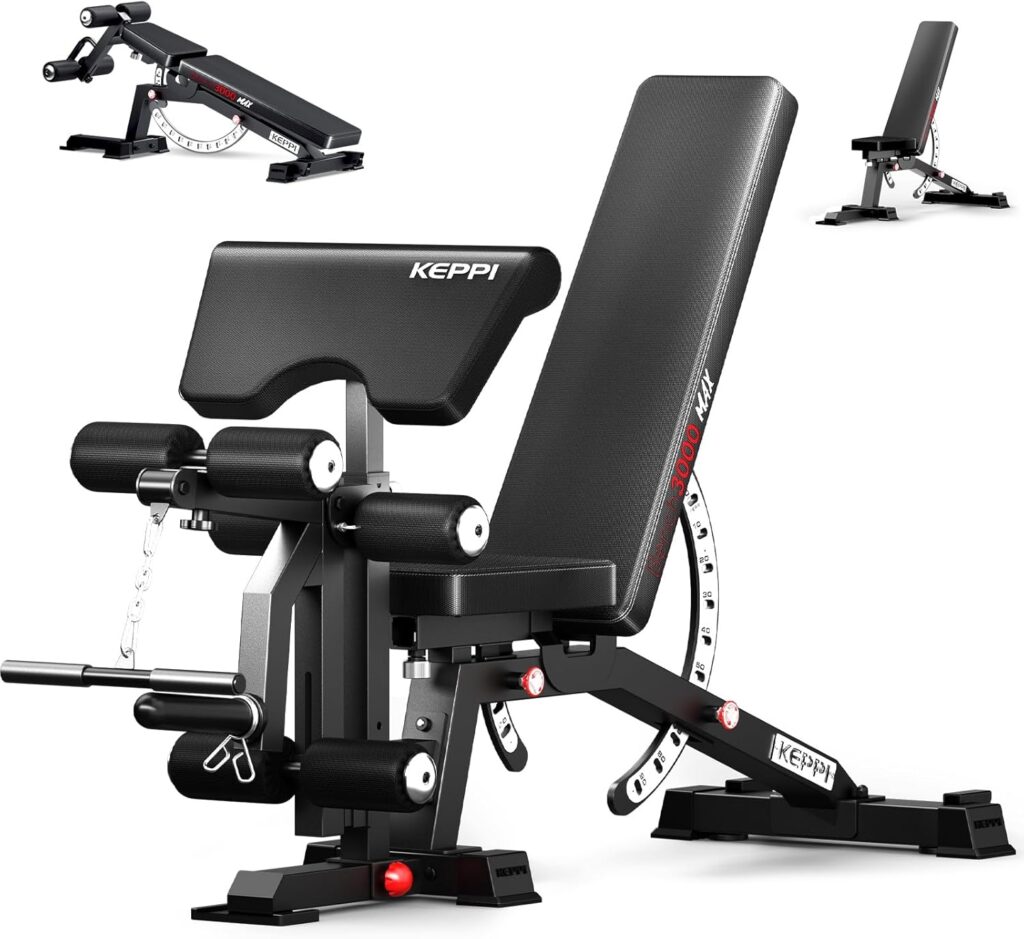
Keppi Bench3000 MAX adjustable weight bench
Build Quality: Is the Steel Frame Actually Heavy-Duty?
This is the question that matters most, because a wobbly bench under a 225 lb bench press is a recipe for either a missed lift or an injury. The Bench3000 MAX uses a frame built from 2.7″ × 1.9″ rectangular steel tubing — noticeably thicker stock than the typical hollow-section steel found on entry-level benches.
In Keppi’s own product page on KeppiFitness.com, they call out a “double bearing design” where the two rotating sections — the backrest hinge and the leg extension pivot — use sealed bearings instead of bushings or bare bolts. In practice, this means two things: the adjustment motion is smoother, and there’s less play that develops over time as the bench wears in.
Verified buyers consistently echo this. Reviewer James F. on the U.S. listing put it bluntly: “I can tell that it was built to last.” Across 224 reviews on Judge.me, the bench averages 4.84 out of 5 stars — a strong signal that the frame holds up under real training conditions, not just specs on a page.
The 1,200 lb weight capacity is also worth a sanity check. That figure represents total loaded weight (your bodyweight plus the barbell plus plates). For context, REP Fitness’s flagship AB-5000 is rated for 1,000 lbs, and the Rogue Adjustable Bench 3.0 sits at 1,000 lbs as well. Keppi is claiming a higher number than benches that cost two or three times as much. Treat that with healthy skepticism if you’re routinely benching 500+ lbs raw — at those numbers, brand reputation and third-party testing matter more than a manufacturer-stated figure. But for the 95% of home gym lifters working in the 135–315 lb range, the Bench3000 MAX has enormous safety margin.
Adjustability: 12 Back Positions, 3 Seat Positions — Does It Matter?
Most adjustable benches in 2026 ship with 6 to 8 back pad positions. The Keppi Bench3000 MAX offers 12, plus 3 seat positions and a decline setting. That’s a lot of angle options, and the question is whether the extra granularity translates into better workouts or whether it’s a spec-sheet flex.
In my view, more positions help in two specific scenarios:
- Dialing in incline pressing for upper chest emphasis. The sweet spot is somewhere between 30° and 45°, but where exactly depends on your shoulder anatomy. Having 12 stops instead of 6 means you can land on the angle that your shoulders prefer.
- Programming variation across a training block. Switching from 30° one week to 37.5° the next is a small enough change to feel different on your chest while still being measurable.
That said, research-backed guides generally agree that seven back pad positions covers all practically useful training angles. So the 12 positions on the Keppi are a nice-to-have, not a must-have. What matters more is that the FID bench with leg extension design includes a true decline — many “adjustable” benches in this price range fake it with a flat-only configuration, then call themselves multi-angle.
One legitimate complaint surfaces in user reviews: the angle adjustment mechanism uses a locking pin plus a tightening knob, and reviewer James F. noted it can be a pain during a workout — particularly if you over-tighten the knob between sets. A ladder-style adjustment (like REP and Rogue use) is faster between sets but offers fewer positions. There’s a real trade-off here, and the Keppi sits on the “more positions, slightly slower changes” side of the line.
The Leg Extension and Preacher Pad Attachments: Genuine Versatility or Gimmick?
This is where the Keppi Bench3000 MAX separates itself from straightforward FID benches. The included leg developer attachment transforms the bench into a leg extension and lying leg curl station, while the swappable preacher pad turns it into a biceps isolation tool.
The two attachments share a single mounting port, so you swap them out — you don’t run both simultaneously. Setup-wise, this is a 30-second job once you’ve done it twice.
Leg extension experience: Reviewer James F. on Amazon, who is 6’2″, reported using it successfully with up to 120 lbs of plates loaded. He noted that he moved the lower leg padding down to the lowest setting and the leg curl padding to the highest setting to find a comfortable position. That’s the right approach — the pads are adjustable specifically to accommodate different leg lengths and ankle positions.
For most home lifters, having a leg extension at home is a small luxury that pays off over time. You can superset leg extensions with squats, finish a lower-body session with high-rep burnout sets, or use the lying leg curl variation to actually hit your hamstrings (a muscle group that’s notoriously hard to train without dedicated equipment).
Preacher curl pad experience: The preacher pad has fewer moving parts and fewer complaints. It mounts at a fixed angle that’s well-suited for both EZ-bar and dumbbell preacher curls. Combined with the bench’s overall stability, it functions as a legit isolation station.
The caveat: Neither attachment matches the precision of a dedicated commercial machine. The leg extension’s pivot point won’t perfectly track your knee’s natural axis of rotation the way a $3,000 Hammer Strength machine would. If you’re chasing a bodybuilding-show-prep level of detail, you’ll outgrow these. For everyone else — that is, 99% of home gym users — they’re a meaningful upgrade over not having them at all.
Assembly, Comfort, and Day-to-Day Use
Assembly is the most consistent gripe across reviews. The instructions are functional but not great, and one reviewer on Garage Gym Reviews noted similar complaints across this category — “diagrams weren’t the easiest to follow” is a near-universal home gym bench experience. Budget roughly 60–90 minutes for first-time assembly. Have a second set of hands available for the heavier sub-assemblies, and don’t fully torque any bolts until everything is loosely fitted — it’s much easier to align the frame that way.
Comfort-wise, the padding earns positive marks. Multiple verified buyers describe it as comfortable across long sessions. The vinyl cover is fitted snugly to the foam, so there’s no pinching or loose material that shifts during a set. The foam itself is firm — not memory-foam soft — which is what you want for bench press: you don’t want to sink into the pad and lose your arch.
The transport wheels and handle are practical. The bench is heavy (estimated 90+ lbs assembled with attachments), but tipping it onto the wheels and rolling it out of the way after a session is a single-person job.
One ergonomic quirk: because the bench is 77 inches long with the leg attachment installed, it’s longer than a standard flat bench. If your training area is tight, plan your layout before assembly. Removing the leg attachment when not in use shortens the footprint considerably.
Keppi Bench3000 MAX vs. the Competition
Here’s how it stacks up against the most commonly cross-shopped alternatives:
| Bench | Capacity | Back positions | Leg extension? | Approx. Price (CAD) |
| Keppi Bench3000 MAX | 1,200 lbs | 12 | Yes | $300-$400 |
| REP AB-3000 2.0 | 1,000 lbs | 8 | Optional add-on | $400-$500 |
| Rogue Adjustable Bench 3.0 | 1,000 lbs | 7 | Yes (standard) | $1,200+ |
| Flybird WB6 Foldable | 880 lbs | 8 | No | $200-$260 |
| Major Fitness PLT01 | 1,300 lbs | 32 | No | $300-$400 |
The Keppi’s pitch is straightforward: at roughly REP AB-3000 money, you get a higher-rated capacity and a leg extension/preacher pad combo that REP charges extra for. The Rogue is the gold standard but costs three to four times as much. The Major Fitness PLT01 offers more adjustment positions but no attachments.
For the home gym buyer who wants maximum training stations per dollar, the Keppi argument is compelling.
Pros and Cons Summary
Pros:
- Genuinely heavy-duty 2.7″ × 1.9″ steel frame with double-bearing pivots
- 1,200 lb capacity is generous for the price tier
- 12 back pad and 3 seat pad positions cover every realistic training angle
- Removable leg extension and preacher pad add real exercise variety
- Compatible with both Olympic and standard plates
- Built-in wheels and handle make moving it easy
- Strong verified-buyer rating (4.84/5 across 224+ reviews)
Cons:
- Assembly instructions are mediocre — plan 60–90 minutes
- Pin-and-knob adjustment is slower mid-workout than ladder-style designs
- Long footprint (77″ with leg attachment) needs dedicated space
- Stated 1,200 lb capacity is not third-party verified
- Doesn’t store upright like some folding alternatives
Frequently Asked Questions
Is the Keppi Bench3000 MAX worth it for home gym use?
For most home gym lifters, yes. The Keppi Bench3000 MAX adjustable weight bench combines a heavy-duty steel frame, 12 back pad positions, and two functional attachments (leg extension and preacher curl pad) at a price point well below comparable benches from REP Fitness or Rogue. The 1,200 lb capacity gives substantial safety margin for anyone training under 400 lbs, and verified buyer reviews average 4.84 out of 5 stars across hundreds of reports — a strong real-world signal that backs up the spec sheet.
Can I do flat, incline, and decline bench press on the Keppi Bench3000 MAX?
Yes. The Bench3000 MAX is a true FID bench (flat / incline / decline), with 12 back pad positions ranging from flat to near-vertical, plus a dedicated decline setting. The metal locking pin system holds each position securely, and the 1,200 lb total capacity covers most home lifters comfortably for all three pressing variations. This makes it more versatile than the many “adjustable” budget benches that lack a true decline.
How long is the Keppi Bench3000 MAX, and how much space do I need?
The bench measures approximately 77 inches in length when the leg extension attachment is installed. That’s longer than a standard flat bench, so plan for at least 7 feet of clear length and 3–4 feet of width for safe pressing setup. The good news: the leg extension is removable, which shortens the footprint to a more typical adjustable-bench length for storage. Built-in transport wheels make moving it across the gym floor a one-person job.
Does the Keppi Bench3000 MAX work with Olympic barbells and plates?
Yes. The Bench3000 MAX’s leg extension and preacher pad accept both Olympic (2-inch) and standard (1-inch) weight plates. This is unusual flexibility — many benches in this price range only support one or the other. For bench pressing, the bench works under any standard Olympic barbell setup and is compatible with squat racks, power cages, and J-cups from any major brand.
What’s the main downside of the Keppi Bench3000 MAX?
The most common complaint is the assembly process: instructions are functional but not user-friendly, and first-time setup typically takes 60–90 minutes. Some users also find the locking-pin adjustment system slower to operate mid-workout than the ladder-style adjustments on REP and Rogue benches. Neither is a dealbreaker, but if quick angle changes between sets are a top priority, a ladder-style bench may suit you better.
Final Verdict: A Strong Value Pick for Home Gym Training
After weighing the build quality, real-world reviews, and the head-to-head comparison against the heavyweights in this category, the Keppi Bench3000 MAX adjustable weight bench earns a solid recommendation for the home gym lifter who wants maximum training variety without paying premium-brand prices. The heavy-duty frame, generous capacity, twelve back pad positions, and the genuinely useful leg extension and preacher pad attachments add up to more functional value per dollar than almost any competing bench in 2026.
It’s not perfect — assembly is fiddly, and pin-knob adjustments are slower than ladder-style competitors — but the trade-offs land on the right side for most buyers.
Ready to upgrade your home gym? Take another look at the Keppi Bench3000 MAX on Amazon, measure your floor space, and decide whether you’re ready for a heavy-duty adjustable bench that genuinely earns its keep. And if you found this review useful, sign up for our newsletter to get more home gym equipment breakdowns, training guides, and buyer’s checklists delivered straight to your inbox.