
Introduction
If you’ve considered taking creatine, you’ve probably wondered: will I gain weight? The short answer is yes, but here’s the part everyone gets wrong: that weight gain isn’t fat. When creatine supplementation causes you to gain weight, you’re looking at water moving into your muscle cells and lean muscle tissue from improved training performance. Understanding the mechanism behind creatine and weight gain helps you decide whether supplementation makes sense for your fitness goals.
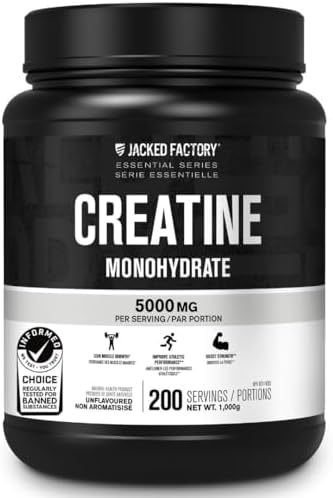
- Pure Creatine Monohydrate Powder: Jacked Factory Creatine Monohydrate powder features 5000mg of unflavored, pure creatin…
- Backed by Science: Creatine monohydrate remains the gold standard of creatine supplements, with hundreds of research stu…
- Naturally Increase Muscle Growth: Creatine supplementation increases strength, power, endurance, and muscle hypertrophy …
What is creatine and how does it work?
Creatine is a compound your body produces naturally from amino acids. You get it naturally from eating meat and fish, but in small amounts. Your muscles use creatine to create phosphocreatine, which helps regenerate ATP (adenosine triphosphate), your cells’ energy currency.
Here’s why athletes care: when you supplement with creatine monohydrate, you’re increasing the amount available in your muscles. More creatine means your muscles can produce more ATP during high-intensity exercise, allowing you to do more reps, lift heavier, or maintain power for longer.
Dosing typically follows two approaches. The loading phase involves taking 20 grams per day (roughly 0.3 grams per kilogram of body weight) split into four doses for 5-7 days, followed by maintenance dosing of 3-5 grams daily. Alternatively, you can skip loading entirely and just take 3-5 grams daily from the start, reaching the same saturation point after 4-6 weeks instead of days.
The most common form is creatine monohydrate, which has the most research supporting its safety and effectiveness.
Why creatine causes weight gain: the three mechanisms
The weight you gain on creatine isn’t a single thing. It’s actually three separate processes, and understanding them matters because they affect your results differently.
Intramuscular water retention (primary)
This is the quick part. When creatine enters your muscle cells, it’s hygroscopic, meaning it pulls water with it. This happens fast during a loading phase and accounts for the majority of weight gain in the first week.
Critically, this water is inside your muscle cells, not under your skin. You won’t look bloated. You’ll actually look fuller in your muscles, a visual change many athletes appreciate.
The numbers: loading phase typically causes 2-5 pounds of weight gain in the first 5-7 days. If you skip loading and take maintenance doses, expect about 0.5-1.5 pounds per week for the first 3-4 weeks as your muscles gradually accumulate water.
This water is completely reversible. When you stop taking creatine, it leaves your muscles within 2-4 weeks.
Enhanced muscle performance (secondary)
Here’s where creatine’s benefit comes in. With better ATP regeneration, you can perform more reps and sets during resistance training. More volume plus better recovery leads to more muscle hypertrophy over weeks and months.
This muscle gain is the good kind of weight gain. Unlike water, muscle stays with you. Build muscle while taking creatine, and that muscle remains even if you eventually stop supplementing (as long as you keep training).
Muscle gain typically appears after 4-12 weeks with consistent resistance training, adding 1-3 kilograms to your total weight.
Body composition vs. scale weight (the important distinction)
Here’s what confuses most people. When you weigh yourself, you’re seeing total weight: water, muscle, fat, organs, everything. Creatine might push you up 4-5 kilograms on the scale, but that doesn’t mean you’ve gained 4-5 kilograms of fat.
The reality: you might gain 3 kilograms of water, 2 kilograms of muscle, and lose 0.5 kilograms of fat all at the same time. The scale shows +4.5 kg, but your body composition actually improved. You’re stronger, you have more muscle, and you’ve lost fat.
This is why scales aren’t the best metric for fitness progress. Body composition analysis using DEXA scans or calipers tells the real story. If you don’t have access to those, taking progress photos and tracking your lifts reveals more than a scale ever will.

Week-by-week timeline: what happens when you start creatine
If you’re considering creatine, here’s what to realistically expect day by day and week by week.
Days 1-7 (loading phase)
If you do the loading protocol (20g daily), the water retention is noticeable and fast. You’ll gain 2-5 pounds within the first week. Your muscles will feel fuller and more volumized.
This dosage is generally split into four to five servings of 5 grams each, taken throughout the day.
This rapid initial gain concerns some people, but understand what’s happening: your muscles are hydrating from the inside. Your thirst increases because your body needs more water to maintain its balance. This is completely normal and expected.
If you skip loading and go straight to maintenance dosing (3-5g daily), this week looks different. Expect 0.5-1.5 pounds of gain instead, spread more gradually.
Weeks 2-3 (stabilization)
On a maintenance dose, water retention plateaus. You’re not gaining a kilogram per day anymore. Your body has stabilized at a new baseline.
But something else is happening: your gym performance improves noticeably. You can hit extra reps, move slightly more weight, or maintain power for an extra set or two. It doesn’t sound dramatic, but that added volume compounds over months.
Your total weight might gain another 0.5-1 kilogram as your muscles finish their hydration adjustment.
Weeks 4-12 (muscle building)
Here’s where creatine’s real benefit emerges. If you’re training hard with resistance, those extra reps and sets translate into actual muscle growth.
Week by week, your strength increases measurably. Lifts that felt heavy in week 3 become your warm-up. Over 8-12 weeks with consistent training, you can realistically gain 1-3 kilograms of lean muscle tissue.
Your total weight gain sits around 2-4 kilograms of water, plus 1-3 kilograms of muscle. The scale is up, but your body composition has shifted positively.
Beyond 12 weeks (steady state)
Weight plateaus at this point unless your diet or training changes. The benefits of creatine are now your baseline. You need to keep taking it to maintain those elevated muscle creatine levels and their performance benefits.
Does it matter where the weight comes from? Gender and body type differences
One question pops up frequently: do women respond differently to creatine? The research is clear: women’s bodies process creatine the same way men’s do.
For women
Clinical research confirms that women respond to creatine supplementation with improved strength and exercise performance. The mechanisms are identical to men’s: water retention plus muscle gain.
Women do typically gain less absolute weight than men (0.5-1.5 kg total compared to men’s 1-3 kg), but this reflects lower baseline muscle mass, not reduced creatine effectiveness. If a woman and man of similar body weight both take creatine, their creatine accumulation rates are identical.
The widespread concern that creatine will cause hormonal imbalances or masculinizing effects has no scientific support. Creatine doesn’t alter testosterone levels or disrupt female hormones. This myth persists online but isn’t backed by clinical evidence.
For different training levels
Your training status affects how much of that weight gain becomes muscle versus staying as water retention.
Beginners often see dramatic strength improvements from creatine because their training stimulus is new. They gain water quickly and build muscle steadily as their body adapts to resistance training.
Intermediate lifters see more modest gains but still noticeable performance improvements. They’ve already built a training base, so the extra rep or two from creatine-enhanced ATP availability compounds over months.
Advanced athletes see smaller relative gains because they’re already training optimally. Creatine helps, but the percentage improvement is smaller compared to beginners.
For sedentary individuals (those not doing resistance training), there’s no muscle-building benefit. Creatine causes water retention, period. Without training stimulus, that water doesn’t drive muscle growth.
What happens if you don’t train while taking creatine?
This is a practical question worth addressing directly. If you take creatine but don’t do resistance training, you’ll gain 1-3 kilograms of water weight with zero muscle gain. That’s water retention without any offsetting benefit.
Should you take creatine if you’re not training? Not really. The supplement’s entire value proposition depends on resistance training. Without that stimulus, you’re gaining weight for nothing.
If you’re sedentary and your doctor recommends creatine for other reasons (age-related muscle preservation, certain health conditions), that’s a different story. But for fitness purposes, creatine only makes sense if you’re committed to strength training at least 3 times per week.
Is the weight gain permanent? What happens when you stop
This is the fear that stops many people from trying creatine: “Won’t I get stuck with permanent weight gain?”
The answer is reassuring: no. Stopping creatine reverses most of the weight gain, and quickly.
Water loss timeline
When you stop supplementing, the water retention reverses within 2-4 weeks. The timeline varies based on how much water you gained initially.
Days 1-7 after stopping: expect 1-7 pounds of water loss. This is where the dramatic drop happens as your muscles excrete the excess intracellular water.
Weeks 2-4: additional slow loss as your body fully returns to its natural creatine levels (which takes 4-6 weeks total).
This isn’t dehydration or something concerning. It’s your muscles returning to their normal hydration state as creatine concentration drops.
Muscle mass preservation when stopping
Here’s the part people misunderstand. The muscle you built while taking creatine doesn’t disappear when you stop. That muscle stays if you keep training.
Research shows that people who stop creatine but continue resistance training don’t lose significantly more lean tissue compared to those who never took creatine. The initial weight loss is water, not muscle.
Your strength might dip slightly during the water loss phase because you’re losing the performance-enhancing effect of high muscle creatine levels. But this is temporary and subtle, not a dramatic loss of strength or power.
Safety considerations and who should avoid creatine
Creatine is one of the most researched supplements in sports nutrition. The safety profile is strong for healthy adults, but some people should avoid it.
Avoid creatine supplementation if you have kidney disease, liver disease, thyroid issues, or diabetes without medical clearance. If you’re taking medications, check with your doctor about potential interactions.
Creatine isn’t recommended for children (limited research on developing bodies), teens (same reasoning), or pregnant or nursing women (unknown effects on fetal and infant development).
Stay hydrated. Creatine increases your water needs. Drink 2-3 liters of water daily minimum, more if you’re active.
Common myths worth dismissing: creatine doesn’t damage kidneys in healthy people, it’s not a steroid, and it’s not banned in most sports. The available safety data spans decades and millions of users. Serious adverse effects are rare and typically occur in people with pre-existing conditions.
Making the decision: is creatine right for you?
Whether to take creatine depends on your training and goals.
For athletes and serious gym-goers
If you train with weights 4+ times per week and want to maximize muscle gain and strength, creatine is worth trying. It’s one of the most researched, effective, and affordable supplements available. The weight gain is desirable (mostly muscle plus water), and the performance benefits are well-established.
Cost is low compared to other supplements. A month’s supply costs $10-20 for creatine monohydrate, the most cost-effective option.
For casual fitness enthusiasts
If you hit the gym 2-3 times per week, creatine helps but isn’t essential. The benefits are real but modest. Weight gain is minimal (0.5-1 kg total) if you’re training at this frequency.
The decision comes down to: do you want every possible advantage, or is it not worth the effort? There’s no wrong answer here.
For non-training individuals
Skip it unless a doctor specifically recommends it. Without resistance training, you gain water weight with no offsetting muscle benefit. The supplement doesn’t make sense without training stimulus.
Getting started with creatine safely
If you’ve decided to try creatine, here’s the practical approach.
Buy creatine monohydrate. It’s the gold standard, most researched form, and cheapest option. Other forms (ethyl ester, buffered) don’t offer proven advantages and cost more.
You have two dosing options. Loading protocol: 20 grams daily (5 grams four times) for 5-7 days, then 3-5 grams daily. Non-loading: just take 3-5 grams daily from day one, reaching the same saturation point after 4-6 weeks. Both work identically long-term. Loading is faster but sometimes causes GI issues; maintenance is gentler on your stomach.
Hydration is non-negotiable. Increase your water intake by 1-2 liters daily. Creatine works by pulling water into your muscles, so adequate hydration supports this process and keeps you healthy.
Take it consistently. Creatine builds up in your system over time. Skipping days or weeks slows progress. Pick a time (breakfast, post-workout, whenever) and take it the same time daily.
Pair it with resistance training. Without weightlifting, creatine’s benefits won’t materialize. Make sure your training is solid before adding supplementation.
Track your progress with bodyweight and photos, not just the scale. Weight goes up due to water and muscle, not fat. Progress photos show the real body composition change better than any number.
Monitor how you feel. Most people tolerate creatine excellently. If you experience any unusual symptoms, stop and consult your doctor.
Frequently Asked Questions
Can creatine make you gain belly weight?
No. Water retention from creatine is intramuscular (inside muscle cells), not subcutaneous (under your skin). You won’t develop belly fat or traditional bloating. If your appearance changes, it’s muscle fullness, which most athletes consider desirable.
What happens after 1 month of creatine?
With loading: week one shows 2-5 pounds of water gain, then it plateaus. Performance improves over weeks 2-4 as your body adapts. Muscle gain begins appearing by week 3-4 if you’re training hard. Non-loading protocol is more gradual but reaches similar results by 4-6 weeks.
Why did I gain 10 pounds after taking creatine?
Ten pounds is on the high end, but possible if you did a loading phase (rapid water gain), started eating more due to improved appetite and training intensity, or combined creatine with a calorie surplus. Verify with body composition analysis whether it’s water, muscle, or fat.
Does creatine make you gain weight without working out?
Yes, but only water retention (1-3 kg max). Without resistance training stimulus, there’s no muscle gain to accompany that water. The weight gain provides no benefit without training, so supplementing makes no sense for sedentary individuals.
Is creatine weight gain reversible if I stop taking it?
Mostly, yes. Water loss occurs within 2-4 weeks of stopping. Muscle built while taking creatine stays if you continue training. Only discontinue creatine completely if you stop training, as maintaining muscle becomes harder without its performance-enhancing effect.
Do women need different dosing or experience different results from creatine?
No. Women accumulate creatine at the same rate as men. Absolute weight gain is typically lower for women (0.5-1.5 kg vs. men’s 1-3 kg) due to lower baseline muscle mass, not differential response. Dosing is the same. Creatine does not cause hormonal changes in women.
Is creatine safe to take long-term?
Yes, for healthy adults. Decades of research supports long-term safety. Avoid if you have kidney disease, liver disease, or uncontrolled diabetes. Stay hydrated and monitor how you feel. Most people tolerate creatine indefinitely without issues.
References and Resources
| Topic | Source URL |
|---|---|
| Water retention mechanism | https://pmc.ncbi.nlm.nih.gov/articles/PMC7871530/ |
| Gender differences | https://pmc.ncbi.nlm.nih.gov/articles/PMC7998865/ |
| Weight gain timeline | https://health.clevelandclinic.org/creatine-loading-phase/ |
| Women’s response | https://www.sciencedirect.com/science/article/abs/pii/S0899900722002040 |
| Without training | https://www.unsw.edu.au/newsroom/news/2025/03/sports-supplement-creatine-makes-no-difference-to-muscle-gains-trial-finds |
| Stopping creatine | https://www.bubsnaturals.com/blogs/creatine-and-fitness/stopping-creatine-what-happens-and-will-you-lose-weight |
| Safety profile | https://www.mayoclinic.org/drugs-supplements-creatine/art-20347591/ |